A research gastric peptide studied in models of tissue, tendon, blood-vessel and gastrointestinal healing
Overview
BPC-157 is a synthetic peptide of 15 amino acids, defined in the literature as a stable gastric pentadecapeptide. The name BPC is an abbreviation of Body Protection Compound, referring to its conceptual origin in sequences associated with protective proteins in the gastrointestinal tract [1,2]. Interest in BPC-157 developed mainly from preclinical studies. The peptide has been examined in models of gastrointestinal injury, wound healing, tendon and ligament injuries, angiogenesis, nerve injury, liver injury and inflammation models [1-5]. However, the level of evidence in humans is far lower than the level of evidence in animals. Because of the gap between the extent of preclinical research and the absence of large clinical trials, BPC-157 is a clear example of a molecule with interesting biological potential but without a sufficient clinical basis for determining efficacy and safety in humans.
Biological Mechanism
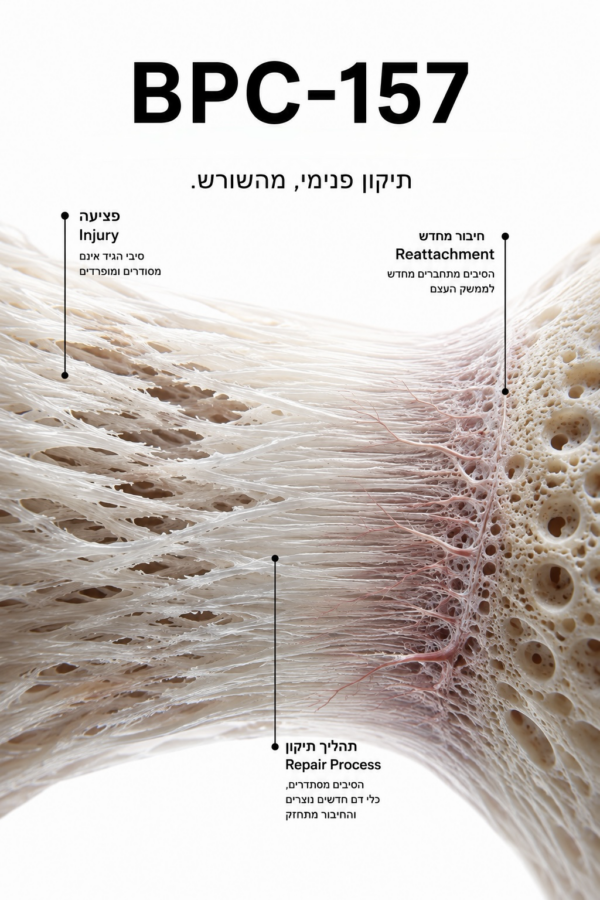
The exact mechanism of BPC-157 is not fully agreed upon. Studies suggest involvement in pathways of angiogenesis, blood-vessel maintenance, the NO response, cell migration, inflammation regulation and remodeling of collagen and the extracellular matrix [3-6]. In a study on tendon cells, BPC-157 was found to increase cell survival, migration and spreading, processes important for the repair of connective tissue [1]. Another study found that BPC-157 may contribute to ligament healing in a rat model, with improvement in structural and functional measures [2]. The connection to angiogenesis is particularly significant. A study in the Journal of Molecular Medicine found that the pro-angiogenic activity of BPC-157 is associated with activation of the VEGFR2-Akt-eNOS pathway [6]. The formation of new blood vessels can support healing, but in certain biological contexts angiogenesis is not necessarily desirable. This mechanism is therefore both a reason for research interest and a reason for caution.
Research Evidence
In tendon-injury models, BPC-157 has been studied particularly in the context of the Achilles tendon. A preclinical study showed acceleration of healing processes in an injured tendon, and further studies supported the possibility that the peptide affects tendon cells and the matrix [1,3]. In models of ligaments and connective tissue, improvement was reported in measures related to healing and tissue integrity [2]. A review published in Cell and Tissue Research in 2019 summarized the information on BPC-157 in musculoskeletal injuries and emphasized that most of the evidence comes from animal experiments and laboratory systems [4]. A broad review in Frontiers in Pharmacology from 2021 presented BPC-157 as a research compound with effects in many models of wound healing and systemic injuries [5]. At the same time, these reviews are not a substitute for large, randomized, controlled clinical studies in humans.
The Digestive System, Blood Vessels & Connective Tissue
The literature on BPC-157 returns again and again to the axis between the gastrointestinal system and systemic healing. The peptide was described as a stable gastric pentadecapeptide, and much of the early research focused on protection of the gastric mucosa, on ulcers and on models of intestinal injury [5]. Research was later expanded to tissues that are not part of the gastrointestinal system, including tendons, ligaments, muscle, nerve and blood vessels [1-6]. This expansion is both a source of interest and a source of caution: a molecule that appears active in many models does not necessarily have a single, clear mechanism. In tendon and ligament injuries, the central question is not only wound closure but the restoration of mechanical structure. A tendon and a ligament require precise arrangement of collagen, a strong attachment to bone or muscle, a limited but adequate blood supply, and coordination between tendon cells and the extracellular matrix. Studies of BPC-157 in tendon cells and in orthopedic models suggest involvement in cell migration, cell survival and tissue arrangement [1-4]. However, most of these studies are not clinical studies in humans, and are therefore better suited to understanding mechanism than to establishing a treatment. The connection to the vascular system is one of the most complex issues. On the one hand, tissue healing requires angiogenesis and repair of blood vessels. On the other hand, activation of vascular pathways is not desirable in every biological situation. The VEGFR2-Akt-eNOS pathway associated with the pro-angiogenic effect of BPC-157 explains why the peptide has been studied in healing, but also why caution is required in the contexts of tumors, vascular diseases or chronic inflammatory processes [6]. Another major limitation is the concentration of the literature around certain research groups and recurring models. There is a relatively large volume of preclinical papers, but less broad independent replication and fewer modern clinical studies. The assessment of the evidence should therefore distinguish between consistency within experimental models and clinical validation. Broad reviews present an interesting biological picture, but they are not a substitute for randomized, controlled trials in humans [4,5].
Safety & Regulation
The central safety gap is the absence of sufficient human data. Positive results in rats or in cellular models do not allow inferences about pharmacokinetics, degradation, immunogenicity, drug interactions or long-term effects in humans. The FDA notes that BPC-157 is among substances that may present safety risks in the context of compounding, including concerns regarding immunogenicity, peptide-related impurities and characterization of the active substance [7]. USADA notes that BPC-157 is regarded as an experimental substance not approved for ordinary clinical use, and it is prohibited under the WADA rules within category S0 of non-approved substances [8]. Further questions include a possible effect on blood vessels, the inflammatory response, tissues with active growth processes, underlying conditions and prolonged exposure. All of these require a clear separation between preclinical research and clinical conclusions.
The Gap Between Popularity and Clinical Support
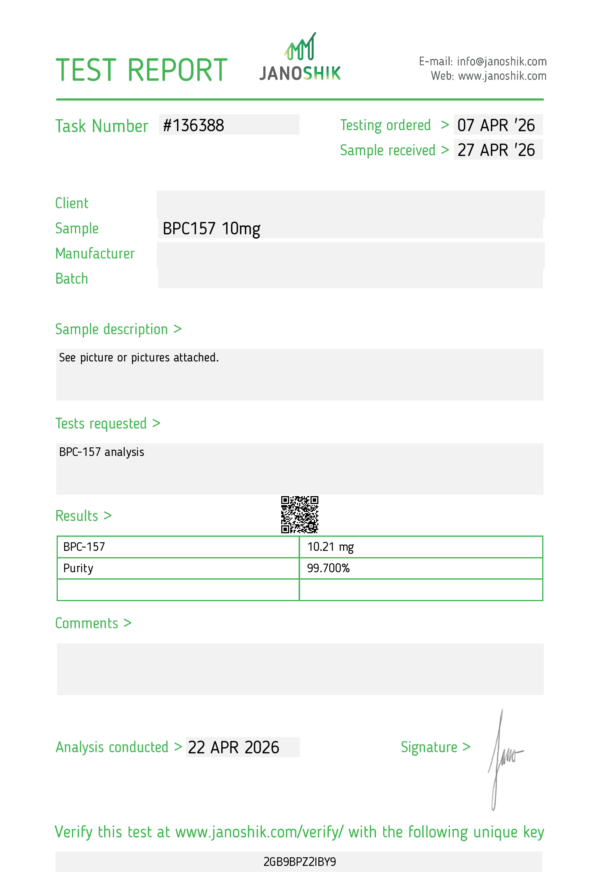
The popularity of BPC-157 in discussion of tendon healing and sports injuries does not necessarily reflect the level of clinical evidence. In most cases, the strongest claims rely on rat studies, cell cultures and reviews that consolidate preclinical models [1-5]. Such studies are important, but they do not answer questions such as variability between humans, safety under repeated exposure, effect in underlying conditions, material quality and follow-up of functional outcomes. The definition of "healing" also differs between models. In the laboratory one can measure cell migration, protein expression, microscopic structure or the mechanical strength of tissue. In a human, healing of a tendon or ligament includes pain, range of motion, return to function, risk of re-rupture, suitability for physiotherapy rehabilitation and the effect on adjacent tissues. Therefore, a peptide that shows improvement in a single measure in an animal model does not necessarily improve the overall clinical outcome. There is also a question of chemical identity and quality. BPC-157 is a synthetic peptide, and so differences in manufacturing, purity, degradation products and chemical characterization can affect the significance of the research and the possible risk [7]. This issue is especially prominent in substances that are not approved drugs and are not always manufactured under a uniform regulatory framework. Another important aspect is the choice of outcomes in future research. Instead of settling for microscopic measures or a description of "accelerated healing," a clinical study will need to examine genuine function: return to movement, pain over time, tissue strength, rate of re-injury, need for surgery or further treatment, and late adverse effects. Without such outcomes, it is difficult to know whether the biological effect seen in the laboratory translates into real medical value. In addition, future studies should include systematic safety monitoring, not just a description of local improvement, because tissue healing also involves blood vessels, the immune system and growth processes [5-7].
Summary
BPC-157 is a research peptide examined in pre-clinical models of tissue, tendons, ligaments and the digestive system, alongside cell-migration, angiogenesis and extracellular-matrix pathways [1-6]. The evidence in humans is very limited and the safety assessment is incomplete. It is a molecule of research interest only, not an established clinical platform; the material is intended for laboratory research only and not for human use.
Selected Research Sources
- Chang C.H. et al. Pentadecapeptide BPC 157 enhances the growth hormone receptor expression in tendon fibroblasts and improves tendon healing. Journal of Applied Physiology, 2011. PMID: 21030672
- Cerovecki T. et al. Pentadecapeptide BPC 157 improves ligament healing in the rat. Journal of Orthopaedic Research, 2010. PMID: 20225319
- Krivic A. et al. An effective therapy of transected quadriceps muscle in rat: gastric pentadecapeptide BPC 157. Journal of Orthopaedic Research, 2006. PMID: 16211507
- Gwyer D. et al. The role of BPC 157 in musculoskeletal soft tissue healing. Cell and Tissue Research, 2019. PMID: 30915550
- Seiwerth S. et al. Stable Gastric Pentadecapeptide BPC 157 and Wound Healing. Frontiers in Pharmacology, 2021. PMID: 34267654
- Hsieh M.J. et al. Pro-angiogenic effects of BPC 157 are associated with VEGFR2 activation and downstream signaling. Journal of Molecular Medicine, 2017. PMID: 27847966
- U.S. Food and Drug Administration. Safety risks associated with certain bulk drug substances nominated for use in compounding. Entry for BPC-157. FDA.gov
- USADA. BPC-157: Experimental peptide prohibited under WADA S0 category. USADA.org




Reviews
There are no reviews yet.