Overview
CJC-1295 and Ipamorelin are two synthetic peptides related to the growth hormone pathway, but they do not act on the same receptor. CJC-1295 is an analog of GHRH, that is, a peptide designed to activate the receptor for growth hormone releasing hormone in the pituitary gland. Ipamorelin is a growth hormone secretagogue from the ghrelin mimetics family, acting through the GHSR-1a receptor [1-4]. Their combination is known in popular discourse as a 'combo', because each of them affects the GH/IGF-1 axis via a different pathway. However, it is important to distinguish between a theoretical biological basis and direct clinical evidence. Most of the research published in humans examined CJC-1295 or Ipamorelin separately, and not the combination as a validated clinical protocol [1-4]. The GH/IGF-1 axis is involved in growth, metabolism, body composition, bone, connective tissue, sleep and tissue repair. Any intervention in this pathway therefore requires research caution, especially when it involves prolonged exposure or populations with underlying metabolic, cardiac or oncological conditions.
Biological Mechanism
CJC-1295 acts through the GHRH receptor and promotes the secretion of growth hormone from the somatotroph cells in the pituitary. The CJC-1295 version with DAC was designed to bind to albumin and significantly prolong the duration of biological exposure, compared with natural GHRH or short-acting analogs [1,2]. Ipamorelin acts through ghrelin receptors, or GHSR-1a. In the original study that described it, it was presented as a relatively selective growth hormone secretagogue, with less effect on ACTH and cortisol compared with some of the older secretagogues [3]. Biologically, activation of GHSR is not identical to activation of GHRH, and it is therefore plausible that these pathways can affect GH secretion patterns in a complementary manner. The increase in GH can lead to an increase in IGF-1, mainly via the liver but also in other tissues. IGF-1 is a central mediator of some of the anabolic and metabolic effects of GH. At the same time, this system is subject to complex negative feedback, so an artificial disturbance of the axis does not necessarily reproduce a normal physiological pattern.
Research Evidence
In a clinical study of CJC-1295 in healthy adults, a prolonged increase in GH and IGF-1 levels was observed after a single exposure, with a longer duration of activity than expected for a short GHRH peptide [1]. Another study showed that even under continuous stimulation with CJC-1295, pulsatile GH secretion is preserved, although the secretion patterns change relative to baseline [2]. Ipamorelin was described in preclinical and pharmacological research as a relatively selective GH secretagogue [3]. Studies on GH secretagogues in general indicate that the ghrelinergic pathway affects GH secretion, appetite, metabolism and other functions, but not every ghrelin receptor agonist behaves in the same way [4]. As for the combination itself, the controlled clinical literature is sparse. Therefore, when referring to the CJC-1295 + Ipamorelin Combo, the level of evidence should be considered lower than the level of evidence for each peptide separately. There is no broad research basis proving a consistent clinical advantage of the combination over other interventions in the GH/IGF-1 axis.
Distinguishing Growth-Hormone Stimulation from Hormone Replacement
The difference between growth hormone secretagogues and administration of external growth hormone is fundamental. Secretagogues attempt to activate the pituitary gland so that it secretes GH through the body's own mechanisms, whereas administration of GH bypasses some of the control mechanisms. However, even 'endogenous' stimulation of the axis is not necessarily entirely physiological. CJC-1295 with DAC significantly prolongs exposure relative to natural GHRH, and can therefore create a more sustained stimulation than the short, cyclical pattern that characterizes the natural hormone [1,2]. Ipamorelin adds another layer, because it activates GHSR-1a, the receptor to which ghrelin-like secretagogues bind [3,4]. This pathway is involved not only in GH secretion but also in appetite, the digestive system, metabolism and neural systems. Therefore, even though Ipamorelin was described as relatively selective for GH release in early studies, it should not be concluded that all of its biological activity is limited to the GH axis alone [3,4]. The claim of 'synergy' between CJC-1295 and Ipamorelin rests mainly on the biological rationale of activating two different pathways, and not on a broad body of clinical research examining the combination itself. Studies on CJC-1295 demonstrated a prolonged increase in GH and IGF-1, and studies on Ipamorelin demonstrated GH release via a GHRP-like pathway, but combining the two molecules raises additional questions: how the natural GH pulse changes, whether there is a change in receptor sensitivity over time, and what the effect is on glucose, fluids, connective tissue and the theoretical risk in situations of unwanted growth [1-5]. The interpretation of an increase in IGF-1 requires particular caution. IGF-1 is a central biological marker of GH effect, but it is not a clinical outcome measure in itself. An increase in it does not prove an improvement in body composition, recovery, sleep or function, and it is also not free of concerns. The GH/IGF-1 pathway is related to growth processes, metabolism and insulin sensitivity, so prolonged exposure requires a broader safety assessment than the measurement of a blood hormone alone. From a regulatory standpoint, the fact that the two peptides appear in compounding discourse does not make them approved drugs or products of guaranteed quality. The FDA separately addresses questions of immunogenicity, peptide-related impurities, characterization of the substance and limited safety data [5]. In competitive sport, the very involvement in the GH/IGF-1 axis explains why substances from the GHRH families and GH secretagogues are considered particularly sensitive in the anti-doping context [6].
Safety & Regulation
The FDA notes that CJC-1295 and Ipamorelin are on the list of substances that may present safety risks in the context of compounding. For CJC-1295, reports of serious adverse events were mentioned, as well as concerns related to immunogenicity, peptide-related impurities and characterization of the active substance. For Ipamorelin, limited safety data and similar concerns regarding quality and immunogenicity are noted [5]. In terms of competitive sport, substances that affect GH secretion, including GHRH analogs and growth hormone secretagogues, fall under prohibited categories in the relevant anti-doping lists [6]. This does not establish a medical conclusion for the general population, but it is important in the context of regulation and of unsupervised use. The theoretical risks of GH/IGF-1 stimulation include effects on glucose, edema, intra-tissue pressure, connective tissue, symptoms resembling GH excess, and an undesirable effect in conditions where growth pathways are already pathologically active. The quality of the substance, sterility and chemical characterization are an integral part of the risk assessment.
Biological Markers vs. Functional Outcomes
A large part of the literature on CJC-1295 and Ipamorelin focuses on hormonal measures: GH, IGF-1, duration of response and secretion pattern [1-3]. These measures are important for understanding activity, but on their own they do not prove functional benefit. To establish a real clinical effect, measures are needed such as a validly measured change in body composition, muscle function, bone quality, recovery from injury, sleep quality, glycemic control and side effects over time. The absence of controlled studies on the combination creates an additional difficulty. Even if each molecule acts through a known pathway, combining them can change the intensity, duration and timing of hormonal signals. The GH/IGF-1 system is sensitive to negative feedback, age, nutritional status, sleep, physical activity and underlying conditions. Claims of a 'natural' or 'physiological' effect of the combination should therefore be examined carefully against direct data, and not only against a theoretical model. In a high-quality future study, it will be necessary to distinguish between CJC-1295 with DAC, shorter GHRH analogs, Ipamorelin alone and various combinations. Without this distinction it is difficult to know which component is responsible for each change, and whether the possible advantage comes from prolonged stimulation, pulsatile stimulation, or a combination of the two.
Summary
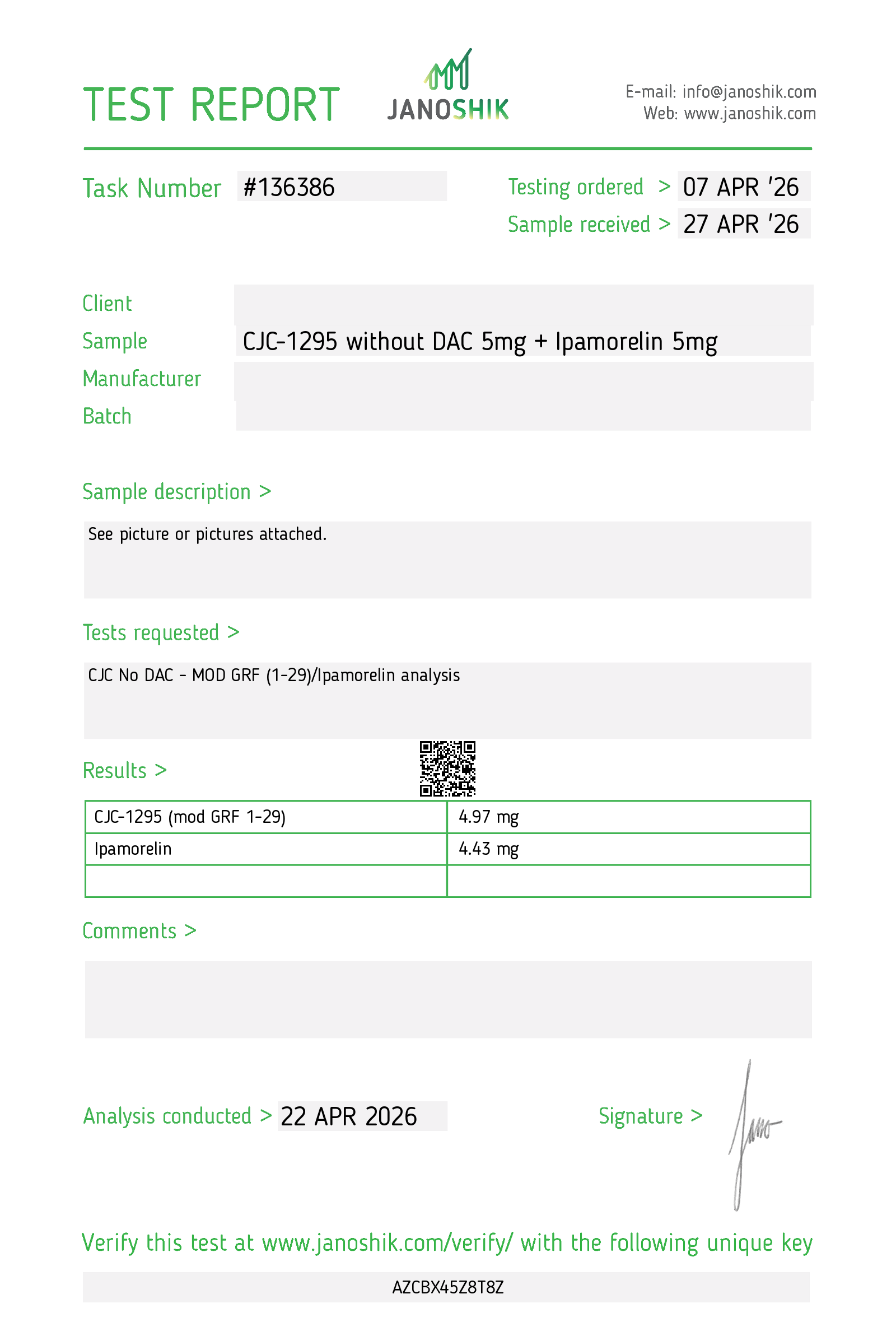
CJC-1295 + Ipamorelin is a research topic around activating two pathways that influence growth-hormone secretion. The direct evidence on the combination is limited, and the stronger studies refer to the molecules separately [1-4]; significant questions remain about efficacy, long-term safety, quality and regulation [5,6]. The material is intended for laboratory research only and not for human use.
Selected Research Sources
- Teichman S.L. et al. Prolonged stimulation of growth hormone and insulin-like growth factor I secretion by CJC-1295, a long-acting analog of growth hormone-releasing hormone, in healthy adults. Journal of Clinical Endocrinology and Metabolism, 2006. PMID: 16352683
- Ionescu M.I., Frohman L.A. Pulsatile growth hormone secretion persists during continuous stimulation by CJC-1295, a long-acting growth hormone-releasing hormone analog. Journal of Clinical Endocrinology and Metabolism, 2006. PMID: 17018654
- Raun K. et al. Ipamorelin, the first selective growth hormone secretagogue. European Journal of Endocrinology, 1998. PMID: 9849822
- Bona G., Bellone S. Ghrelin and the growth hormone secretagogue receptor. Panminerva Medica, 2003. PMID: 14618118
- U.S. Food and Drug Administration. Safety risks associated with certain bulk drug substances nominated for use in compounding. Entries for CJC-1295 and Ipamorelin acetate. FDA.gov
- World Anti-Doping Agency. The Prohibited List. Categories related to peptide hormones, growth factors and growth hormone secretagogues. WADA-ama.org



Reviews
There are no reviews yet.