A long-acting GHRH analog; the DAC is a modification for albumin binding, not an additional peptide
Overview
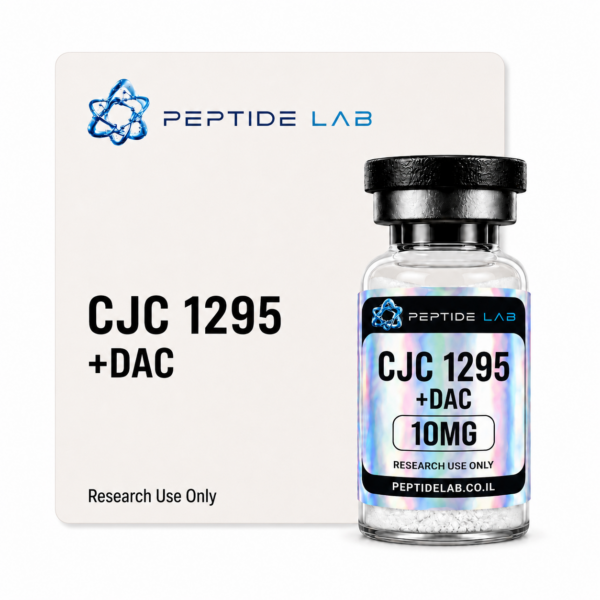
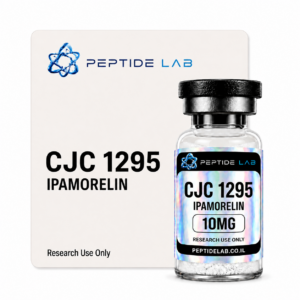
CJC-1295 with DAC is a long-acting synthetic analog of growth hormone-releasing hormone (GHRH). Chemically, "DAC" is not an additional peptide added to CJC-1295; it is an abbreviation of Drug Affinity Complex, a modification designed to allow covalent binding to albumin in the blood and to prolong the peptide's exposure time [1,4]. The term "CJC + DAC" is therefore an imprecise way of saying CJC-1295 DAC. A distinction should also be made between CJC-1295 DAC and shorter compounds sometimes referred to as "CJC-1295 without DAC" or Mod GRF(1-29); these are not equivalent in terms of structure, half-life and research data. CJC-1295 DAC is not an FDA-approved drug. The existing human studies date mainly from the early 2000s and examined the effect on GH and IGF-1 in healthy adults, not long-term clinical outcomes [1-3].
Biological Mechanism
CJC-1295 DAC binds to the GHRH receptor in the pituitary gland and stimulates the release of growth hormone from somatotroph cells. The rise in GH can lead to an increase in IGF-1, mainly via the liver but also in other tissues [1]. The DAC includes a chemical group that enables the formation of a bond with endogenous albumin. Binding to albumin reduces rapid clearance and prolongs the duration of activity relative to natural GHRH or short analogs [1,4]. Prolonging the exposure alters the biology of the system. Natural GHRH acts in short, pulsatile patterns, whereas CJC-1295 DAC provides more sustained stimulation. A human study showed that even under prolonged exposure a degree of pulsatility in GH secretion is preserved, but the profile is not identical to the normal physiological state [2].
Research Evidence
In a clinical study published in 2006 in healthy adults, CJC-1295 caused a sustained, exposure-dependent rise in GH and IGF-1 levels, with an effect that lasted beyond the short window of natural GHRH [1]. A further study from the same period showed that GH pulses did not disappear entirely despite continuous stimulation [2]. A later study examined changes in the serum protein profile following activation of the GH/IGF-1 axis by CJC-1295, and demonstrated that the effect is not limited to the measurement of two hormones alone [3]. That said, the human studies are small and do not prove clinical benefit in areas such as body composition, recovery, sleep, "anti-aging" or performance. A rise in GH and IGF-1 is evidence of pharmacological activity, not evidence of a desirable health outcome.
Prolonged Exposure vs. Physiological Secretion
The GH system operates in a pulsatile manner and is influenced by sleep, nutrition, physical activity, age, somatostatin and GHRH. The question is therefore not only whether CJC-1295 DAC raises GH, but how prolonged exposure alters the coordination between these pathways. The study that showed preservation of a certain pulsatility is important, but it does not prove that the pattern remains entirely physiological [2]. Prolonged stimulation can change the baseline level, the feedback response and the duration of exposure to IGF-1. This difference is particularly significant in comparison with short GHRH analogs, in which exposure is briefer. Data on CJC-1295 DAC should therefore not be conflated with data on short peptides marketed under the same commercial name.
Safety & Regulation
The FDA reviewed several forms of CJC-1295 and CJC-1295 DAC in the context of the bulk drug substances list for compounding and proposed not to include them on the 503A list. The evaluation documents noted limited clinical data, ambiguity regarding the exact form tested in some studies, and preclinical signals warranting caution [4,5]. The FDA also notes serious adverse events reported with CJC-1295, including increased heart rate and a systemic vasodilatory response, as well as concerns regarding immunogenicity, peptide-related impurities and characterization of the active substance [5]. A detailed evaluation document on CJC-1295 DAC noted a lack of long-term carcinogenicity studies, and that chronic stimulation of the GHRH/GH axis raises theoretical questions regarding pituitary hyperplasia and growth pathways [4]. This is not proof of specific harm in humans, but it is a reason why short-term hormone data are not sufficient for a safety assessment.
GH & IGF-1 Markers vs. Clinical Benefit
GH and IGF-1 are key biomarkers, but they are not clinical outcomes in themselves. A rise in them may also be accompanied by effects on glucose, fluid retention, connective tissue and growth systems. It is therefore not possible to infer a net improvement in health from a rise in a hormonal marker. To establish a genuine clinical benefit, studies are needed that measure function, body composition by valid methods, glucose metabolism, sleep quality, quality of life, cardiac events and long-term safety. Studies of this kind do not exist on a scale that would allow CJC-1295 DAC to be defined as an established treatment for the general population.
Summary
CJC-1295 DAC is a long-acting GHRH analog in which the DAC is a chemical modification for albumin binding, not a separate peptide [1,4]. Small human studies described a prolonged rise in GH and IGF-1, but there is no broad clinical basis for long-term benefit, and the FDA has raised concerns about safety, quality and missing data [4,5]. The material is intended for laboratory research only and not for human use.
Selected Research Sources
- Teichman S.L. et al. Prolonged stimulation of growth hormone and insulin-like growth factor I secretion by CJC-1295, a long-acting analog of growth hormone-releasing hormone, in healthy adults. Journal of Clinical Endocrinology & Metabolism, 2006. PMID: 16352683
- Ionescu M.I., Frohman L.A. Pulsatile growth hormone secretion persists during continuous stimulation by CJC-1295, a long-acting GHRH analog. Journal of Clinical Endocrinology & Metabolism, 2006. PMID: 17018654
- Sackmann-Sala L. et al. Activation of the GH/IGF-1 axis by CJC-1295 results in serum protein profile changes in normal adult subjects. Growth Hormone & IGF Research, 2009. PMID: 19386527
- U.S. Food and Drug Administration. Pharmacy Compounding Advisory Committee briefing document on CJC-1295 and CJC-1295 DAC-related bulk drug substances, December 2024.
- U.S. Food and Drug Administration. Certain Bulk Drug Substances for Use in Compounding that May Present Significant Safety Risks. Entry for CJC-1295.



Reviews
There are no reviews yet.