A neuroregulatory peptide studied in the context of anxiety, GABA, enkephalins, and the stress response
Overview
Selank is a short synthetic peptide of seven amino acids, with the sequence Thr-Lys-Pro-Arg-Pro-Gly-Pro. It was developed on the basis of tuftsin, a natural peptide related to the immune system, and has been studied mainly in the contexts of anxiety, the stress response, neurotransmission, and cognitive functions [1-4]. The literature on Selank differs from that of psychiatric drugs that have undergone large global development programs. There are studies in humans, including comparative studies in anxiety patients, but a significant portion of them was published in Russian, in relatively small samples and in a limited number of research centers [1,2]. There is therefore an indication of possible biological and clinical activity, but the level of international validation is limited. Selank is not approved as a drug by the FDA. In the context of compounding, the FDA notes that there is insufficient information on the safety of exposure in humans and that there are possible concerns related to immunogenicity, aggregation, and peptide-related impurities [5].
Biological Mechanism
The mechanism of Selank is not defined as a single pathway. One of the most studied axes is the GABAergic system. Molecular studies have suggested that Selank can affect GABA binding and act as an allosteric modulator of GABA receptors, that is, altering the response of the receptor without simply being a substitute for GABA itself [3,4]. Another axis is related to enkephalins, endogenous peptides involved in the regulation of pain, stress, and emotion. An early study found that Selank inhibits enzymes that degrade enkephalins in plasma, and suggested that prolonging their availability may be part of the explanation for the anxiolytic activity observed in early studies [1]. Gene-expression studies in preclinical models also point to changes in pathways related to neurotransmission, but a change in gene expression does not in itself prove clinical improvement. It is therefore accurate to describe Selank as a neuroregulatory peptide with several proposed mechanisms, and not as a substance with a single, fully proven mechanism.
Research Evidence
In a clinical study that included 62 patients with generalized anxiety disorder or neurasthenia, Selank was compared with medazepam. The researchers reported improvement in anxiety measures in both groups, with certain anti-asthenic effects also described for Selank [2]. Another comparative study examined Selank versus phenazepam in patients with anxiety and phobic disorders and reported anxiolytic activity and relatively good tolerability [6]. However, there are significant limitations: the samples were small, some of the studies are not available in full English, there is overlap between the research groups, and there is no large body of independent multicenter studies. The depth of the evidence should therefore not be equated with that of approved anxiety medications tested in thousands of participants and with long-term follow-up. The preclinical studies support an effect on GABA and enkephalin systems, but the transition from a molecular mechanism to therapeutic benefit requires larger randomized studies, with control groups, predefined outcomes, and long-term safety monitoring [1,3,4].
Anxiety, Cognition, and the Difference Between a Biological Signal and a Clinical Outcome
Selank is sometimes also described in popular discussion as "nootropic," but the literature does not allow a determination of broad, reproducible cognitive improvement in a healthy population. Some of the studies and models point to a possible effect on attention, memory, or the stress response, but such results depend on the model, the population, and the measurement methods. It is especially important to distinguish between a reduction in an anxiety score in a small study and a claim of proven treatment of an anxiety disorder. Clinical treatment requires evaluation of symptom severity, daily functioning, recurrence, interactions with other medications, the risk of paradoxical reactions, and the effect over months and years. Most of these questions are not well covered in the existing literature on Selank.
Safety & Regulation
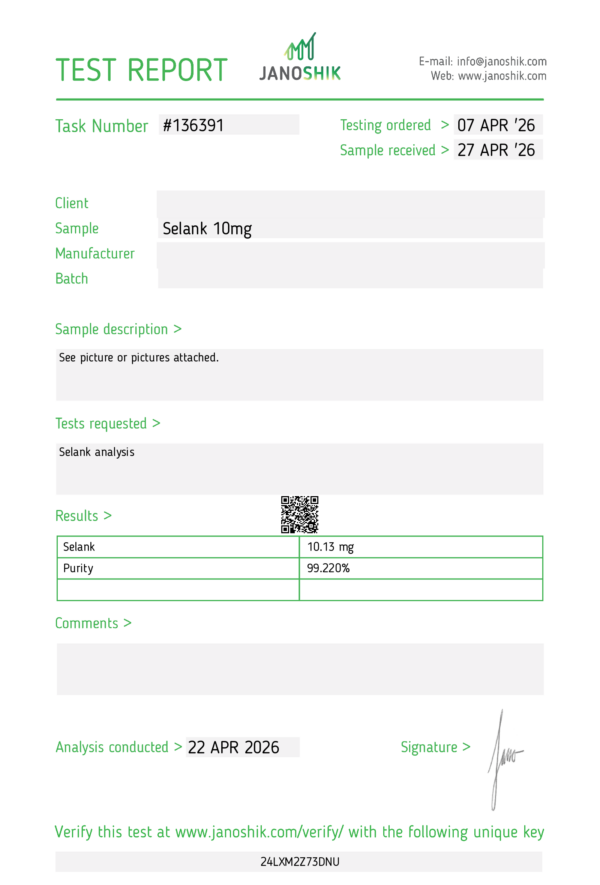
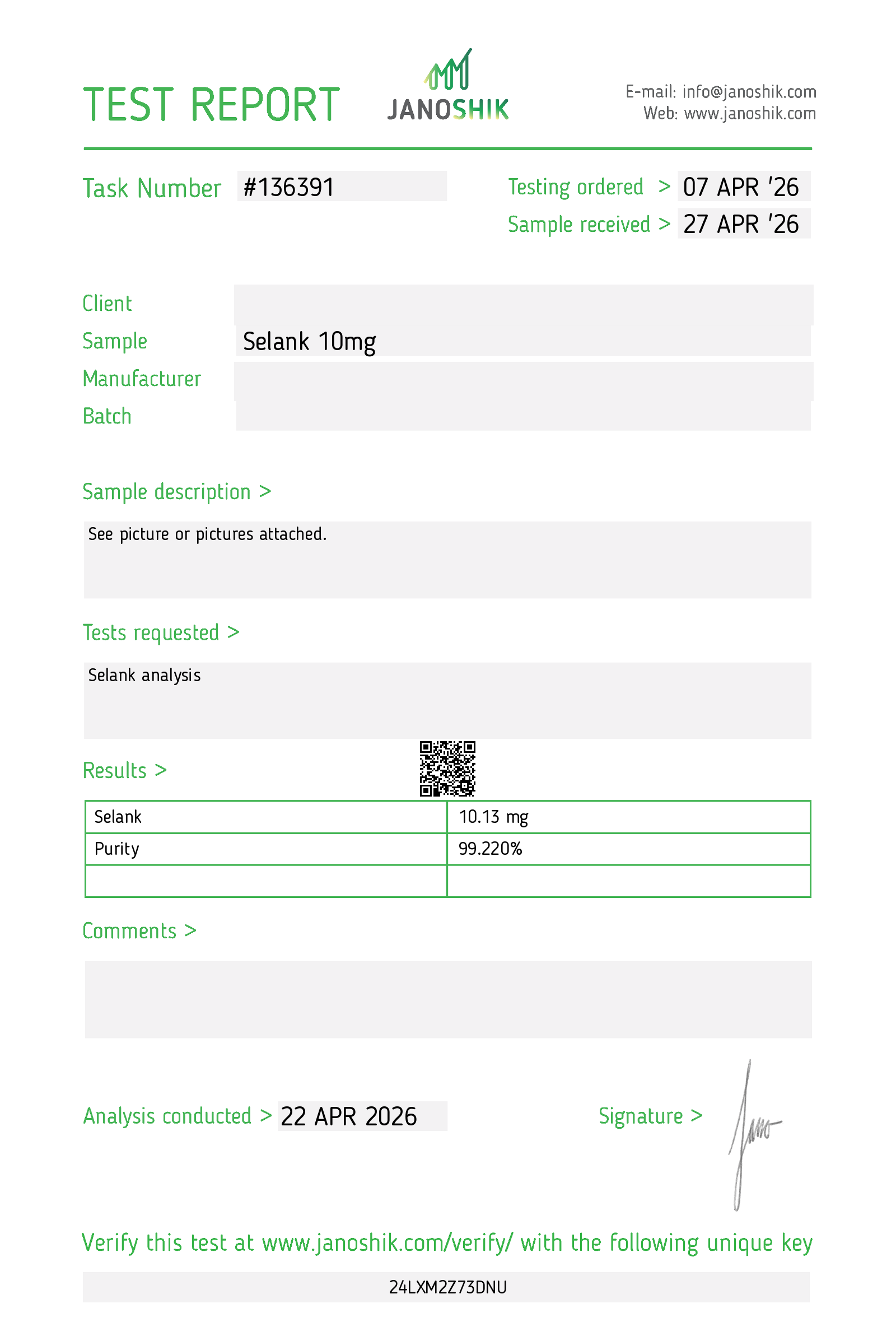
The information on the safety of Selank in humans is relatively limited. In the small published studies, a severe side-effect profile similar to benzodiazepines was not described, but the sample sizes are not sufficient to rule out rare events, long-term effects, or interactions with other psychiatric medications [2,6]. The FDA notes that for selank acetate there is insufficient human information to assess safety, and that compounded products also carry risks that are not related only to the mechanism of the peptide: the purity of the substance, degradation products, aggregation, immunogenicity, and characterization of the active substance [5]. In the absence of a uniform regulatory framework, one should not infer the quality of a particular product from the research quality of a particular molecule. This is a fundamental difference between pharmacological research and a pharmaceutical product that has undergone evaluation of quality, stability, and manufacturing.
Interpretation Limits and the Need for Independent Verification
One of the central limitations of the Selank field is the concentration of a large part of the literature around Russian research groups that were also involved in developing the peptide. This does not invalidate the results, but it reinforces the need for independent replication and multicenter studies. To establish a broad clinical role, studies would be needed that compare Selank with placebo and with a standard of care, examine diverse populations, measure function and quality of life and not only questionnaire scores, and monitor side effects over time. Until then, the most accurate description is an experimental peptide with preliminary human data and interesting neurobiological mechanisms, but with a small evidence base relative to approved treatments.
Summary
Selank is a synthetic neuro-regulatory peptide studied mainly in the context of the GABA and enkephalin systems and the stress response [1-4]. There are small clinical studies, but the body of evidence is limited in size, international replication and long-term follow-up [2,6]; it is not an FDA-approved drug, and the safety assessment of compounded products is incomplete [5]. The material is intended for laboratory research only and not for human use.
Selected Research Sources
- Zozulya A.A. et al. The inhibitory effect of Selank on enkephalin-degrading enzymes as a possible mechanism of its anxiolytic activity. Bulletin of Experimental Biology and Medicine, 2001. PMID: 11550013
- Zozulia A.A. et al. Efficacy and possible mechanisms of action of a new peptide anxiolytic Selank in generalized anxiety disorders and neurasthenia. Zhurnal Nevrologii i Psikhiatrii, 2008. PMID: 18454096
- Vyunova T.V. et al. Peptide-based anxiolytics: the molecular aspects of heptapeptide Selank biological activity. Protein & Peptide Letters, 2018. PMID: 30255741
- Volkova A.A. et al. Selank Administration Affects the Expression of Some Genes Involved in GABAergic Neurotransmission. Frontiers in Pharmacology, 2016. PMID: 26924987
- U.S. Food and Drug Administration. Certain Bulk Drug Substances for Use in Compounding that May Present Significant Safety Risks. Entry for Selank acetate (TP-7), current FDA compounding safety information.
- Medvedev V.E. et al. A comparison of the anxiolytic effect and tolerability of Selank and phenazepam in the treatment of anxiety disorders. Zhurnal Nevrologii i Psikhiatrii imeni S.S. Korsakova, 2014. PMID: 25176261




Reviews
There are no reviews yet.